
Theoretical and Computational Neuroscience Summer School
CNeuro2026 Press Release
CNeuro2026 Summer School Concludes at Tsinghua University in Beijing
The 2026 Theoretical and Computational Neuroscience Summer School (CNeuro2026) was held from July 7 through July 14, 2026, at Tsinghua University in Beijing. The program brought together 31 undergraduates, graduate students, postdoctoral fellows, and early-career researchers from nine countries and regions for lectures, discussions, poster sessions, and interactions with teaching faculty.
Designed for students and researchers with strong backgrounds in mathematics, physics, computer science or engineering, CNeuro2026 drew faculty globally from institutions across Asia, Europe, and North America. Participating scholars hailed from Harvard University, Princeton University, RIKEN, EPFL, the University of Hong Kong, NYU Shanghai, the University of Science and Technology of China, Tsinghua University, and Peking University. The faculty included researchers working in theoretical neuroscience, computational modeling, cognition, and brain-inspired AI.


Figure 1. Teaching Faculty
This year's theme, "Connections between Natural and Artificial Intelligence," asked what neuroscience and AI can learn from one another. Lectures considered how machine-learning tools can support research on brain mechanisms, how biological neural systems may inspire new approaches to AI, and how natural and artificial systems differ.
The curriculum covered both foundation knowledge and current research topics. Introductory sessions covered neural computation, recurrent network models, neural valuation, and behavior across multiple timescales. Advanced sessions examined AI-based cognitive modeling, neural representations in changing environments, causal analysis of circuits and behavior, and AI-driven neuroscience. Throughout the program, mathematical, statistical, and computational methods were presented as practical tools for addressing biological questions.

Figure 2. "Life & Science" Session
The summer school was built around conversation and discussions besides lectures. Daily student-faculty lunches, Life & Science sessions, small-group discussions, and group poster presentations gave participants time to talk through research problems, career choices, and the practical side of academic life.
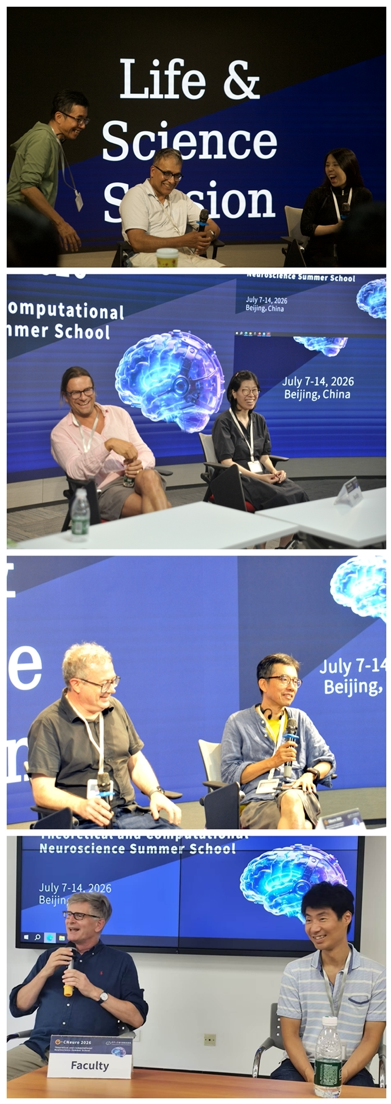
Figure 3. Group Poster Session
On July 11, the summer school hosted a one-day workshop, "Building Bridges: Where Neural Networks Meet Cognition, and Theory Meets Data." Speakers from local Chinese institutions presented work spanning neural modeling, cognitive neuroscience, and data-driven analysis. The workshop gave participants a closer look at current efforts to connect theory with experiment. The workshop closed with a capstone lecture by a historian of science from Johns Hopkins University, framing the questions pursued throughout the week as the latest chapter in a much longer history of technology, machines, and ideas about intelligence and the mind.

Figure 4. One-Day Workshop
CNeuro2026 students came from many countries, including the United States, Russia, Germany, Spain, Mexico, Brazil, India, Korea, and China, and represented a wide range of disciplines and backgrounds. The international cohort enriched conversations outside classroom - during meals, poster sessions, and informal meetings throughout the week.

Figure 5. Group Photo
By the end of the summer school, participants had worked through new methods and ideas while also forming connections with peers and faculty across fields and countries. CNeuro will continue to provide a forum for young researchers interested in the increasingly close relationship among neuroscience, computation, and artificial intelligence.